
Democracy Cannot Survive The Wealth-Power Feedback Loop
Synopsis:
• The problem:
America’s billionaires and trillionaire can buy influence over politicians, Justices, and media, reshaping the rules of society so the wealthiest accrue yet more wealth and power. This is the Wealth-Power Feedback Loop.
• The stakes:
When government consistently serves the few over the many, trust in democracy collapses, and citizens who feel powerless at the ballot box turn to authoritarianism or political violence.
• Why reform has failed:
Fifty years of campaign finance, lobbying, and disclosure rules have not broken the Feedback Loop, and they never will. The First Amendment protects political spending, and the ultra-wealthy will always find workarounds faster than government can close loopholes.
• The insight:
Regulating the flow of money will never break the Loop as long as the reservoir of wealth remains immense. The only solution is to limit the size of the reservoir.
• The proposal:
Cap family wealth at $1 billion. That is ample reward for innovation and enough for the most lavish lifestyle, but too little to dominate a national election or sustain the Feedback Loop.
• The objections don’t hold up:
Innovation flourished when top tax rates exceeded 70%. Billionaire expatriation is rare, and those who renounce citizenship pay a steep exit tax and lose the right to make political contributions.
• The bottom line:
We already set a floor beneath which no American should fall: the poverty line. A wealth ceiling is its natural complement. It would safeguard a democracy that serves We the People. The fewer than 1,000 families above the cap would lose political power, but not a single luxury.
An abbreviated version of this essay will soon be posted at: Democracy Requires a Wealth Ceiling
YouTube video: https://youtu.be/LRVTln1RPKU
Index
An Accelerating Chasm of Wealth Inequity
The Wealth-Power Feedback Loop: Extreme Wealth Confers Inordinate Political Power
Breaking the Wealth-Power Feedback Loop
- How Much Money Does a Person Need?
- How Much Money is Too Much Money?
- Cap Wealth to Encourage Innovation and Abolish the Wealth-Power Feedback Loop
- How to Implement a Wealth Ceiling
Answering the Critics of a Cap on Extreme Wealth
- A Wealth Cap Violates the U.S. Constitution’s 1st and 5th Amendments
- Billionaires Will Renounce Their Citizenship, Taking Their Wealth With Them
- A Wealth Ceiling Will Discourage Innovation and Entrepreneurship
- A Wealth Cap Puts American Entrepreneurs at a Competitive Disadvantage Against Foreigners
- A Wealth Cap Will Reduce Tax Revenue and Charitable Giving
- A Wealth Cap is Unfair to the Uber-Successful
Democracy Cannot Survive The Wealth-Power Feedback Loop
Imagine a democracy in which America’s 20 wealthiest people hold a combined wealth that exceeds everything spent on the 2024 federal election cycle for president, Senate, and House: 200-fold.
That extraordinary wealth has enabled them to become the dominant funders of our political parties and buy and control the newspapers, television networks, and social media platforms through which our national dialogue flows.
That dominance empowers them to override the will of the majority of Americans and write the laws that grow their coffers and accrue yet more political influence.
Now stop imagining.
This is America today.
One can argue that America is no longer a democracy or America is a dysfunctional democracy that no longer serves the interests of the majority of its citizens. The only way to re-establish a government that reliably serves We the People is to eliminate the possibility that wealthy people have the opportunity to disproportionately influence the direction of our democracy.
My Biases
In all that follows, I acknowledge that my first priority is to create an American government that is singularly focused on building a society that enables all Americans to live their best lives in the least restrictive manner, while protecting the civil rights of the minority members of our society. The most efficient way to achieve this end is by fostering “rational capitalism,” an economic system in which the cost of goods and services reflect the long-term cost and benefits to society, while the government focuses on advancing the strategic plan and effectuates services that the private market believes is not profitable.
An Accelerating Chasm of Wealth Inequity
As shown in the World Inequality Database, personal wealth in America is now as concentrated as in some of the world’s most unequal large economies.

America’s wealthiest 0.1% families now hold about six times the wealth as the bottom 50% of our economic hierarchy.

As shown in my essay The Graph That Makes 99.9999% of Americans Disappear, for every $1 owned by an average family in the bottom 50%, each of the ~85 American families whose wealth exceeds ~$10 billion now possess approximately $4,000,000. At the ultimate pinnacle, an individual family in the top 0.000001%—representing a handful of families like Elon Musk, Jeff Bezos, and Mark Zuckerberg—hold an average net worth that is a staggering many of 10-20 million times larger than the average family in the bottom half.
Equally alarmingly, the wealth gap between an average and the wealthiest Americans is increasing at an accelerating rate, with the wealthiest demographic pulling aways at the fastest rate.
Since 1990, the collective share of national wealth held by the bottom 50% has fallen from 3.5% to 2.5%, while the share controlled by the top 0.1% has climbed from 8% to 14%.
America’s wealth gap is now at least as large as any time in our history.

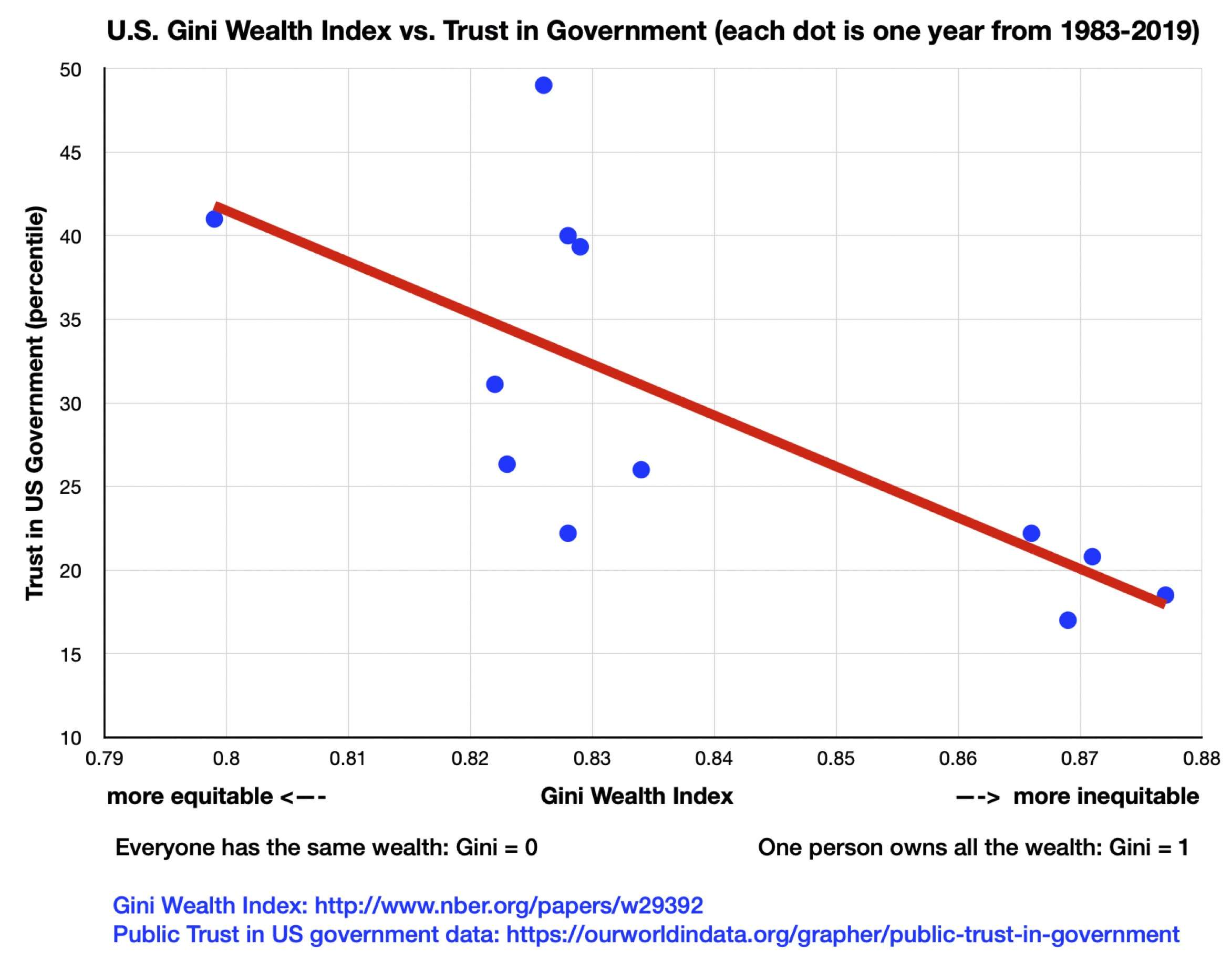
With growing wealth inequity, we see a growing distrust of our government.
The Wealth-Power Feedback Loop: Extreme Wealth – Inordinate Political Power
The immense wealth gap gives America’s multi-billionaires the resources they need to advance their political agenda, and they have done so successfully.
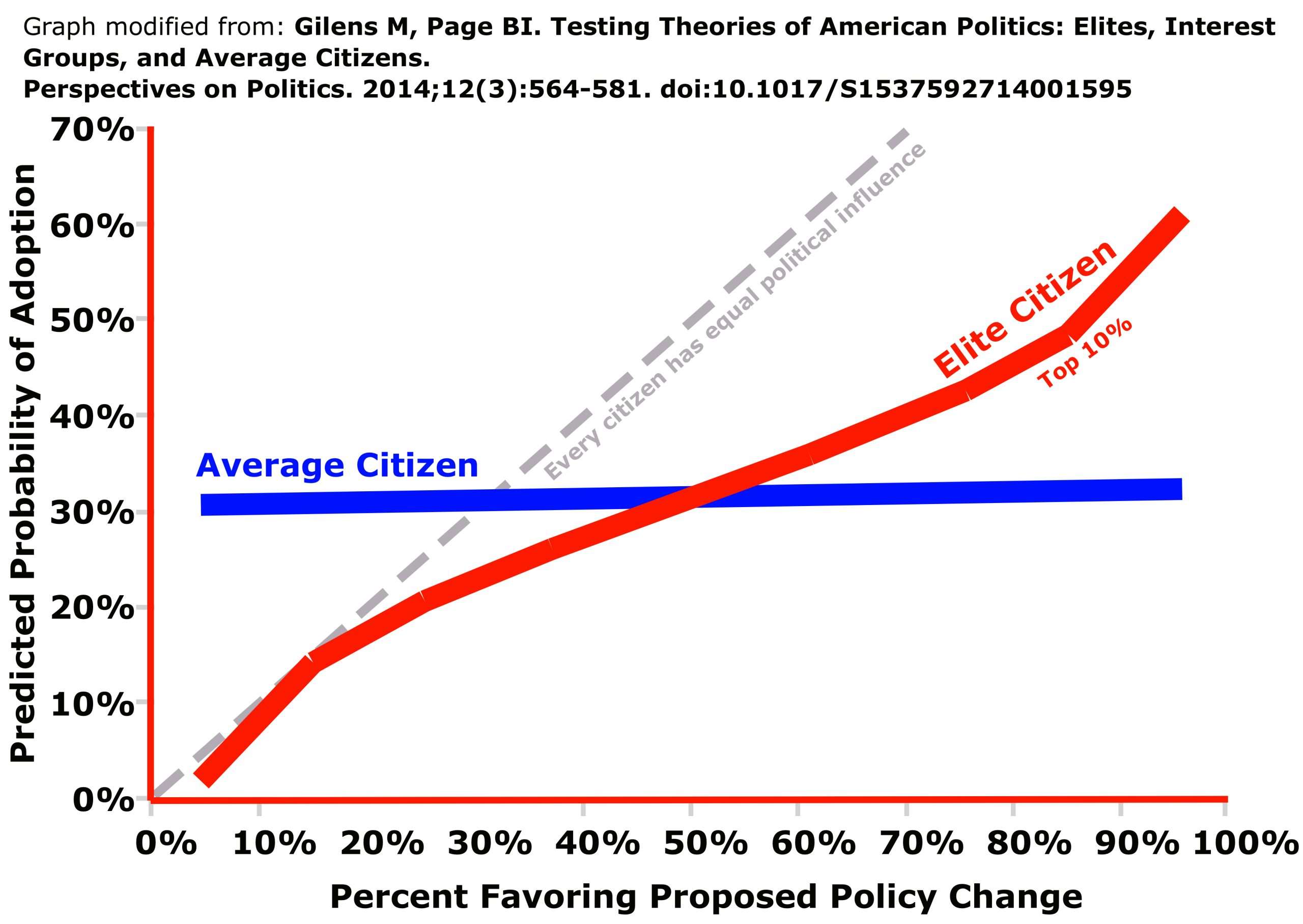
Based on national survey data of 1,779 proposed policy changes that were collected between 1981 and 2002, Gilens and Page found that the public has good reason to distrust their government as:
“that economic elites … have substantial independent impact[s] on U.S. government policy, while average citizens … have little or no independent influence” as shown in the below graph. (The precise size of that gap is debated among political scientists, but the core finding — that concentrated wealth outweighs average citizens in shaping policy — has held up.)
Proving, in the scientific sense, that money directly affects election results is problematic. A controlled experiment is impossible, and “natural experiments” always involve confounding factors; for example, two candidates are never identical in every respect except that one has more money than the other. Yet politicians, political operatives, and academics broadly agree that adequate financial resources are essential to most political campaigns.
Daniel I. Weiner, senior director of the Brennan Center’s Elections and Government Program said on PBS Newshour
“I think money matters. It doesn’t mean that there’s a one-to-one correspondence of dollars to votes. … most candidates, they think they need enough money. They don’t necessarily need more money, and there certainly are diminishing returns. … I would say, though, that victorious candidates generally do have enough money to compete. …I think it can be an oversimplification to just say whoever has the most money in their corner is always going to win.”
Objective analyses show that commercial advertising and political propaganda can increase sales (Old Spice,) sway voters to reject demonstrated facts (Trump’s 2020 election fraud campaign,) and convince people to abandon moral principles (Nazi Germany and Adolf Hitler’s Big Lie.)
As media spending can influence/alter public beliefs/behavior, it is not surprising that Americans for Tax Fairness found that billionaire spending on political campaigns was accelerating through 2024.

A separate analysis by the NY Times found that that a mere 300 billionaire families were responsible for:
“19 percent of all contributions… either directly or through political action committees… The billionaire families gave an average total of $10 million each in 2024, an amount roughly equal to what 100,000 typical political donors gave, combined… Spending by ultrawealthy donors has at times dwarfed that of other contributors, shifting both major statewide elections and lesser-known races where their influence may be harder to discern.”
In August 2026, the NY Times, also found that this trend has continued, with more than $1 billion of “untraceable cash” spent three months prior to the November 2026 mid-term elections.
Beyond direct campaign contributions, the uber-wealthy have more subtle mechanisms to disproportionately alter America’s political priorities and moral underpinnings.
As Paul Krugman noted, the mega-wealthy have always found a way cajole our political system to ensure they accumulate still more wealth or power; including raw corruption (as documented by the American Bar Association, soft corruption (the revolving door of public – private employment, no-show jobs for family members, gifts, lecture fees, congresspersons trading on insider information, etc,) dark, untraceable money, and “defining” the public discourse thru control of media outlets and think tanks. These conclusions were also documented in the NY Times’ report “‘The Least Transparent Midterm’: How Dark Money Is Washing Over the 2026 Election.”
The U.S. has seen several billionaires acquire controlling interests in large media outlets, and many have directly intervened in the editorial process:
- Jeff Bezos killed The Washington Post’s planned endorsement of Kamala Harris
- Patrick Soon-Shiong did the same at the LA Times
- Rupert Murdoch has a long history of shaping the Journal’s coverage and editorial direction
- The Ellison family, owners of Paramount/CBS, fired multiple 60 Minutes journalists after they accused leadership of pressuring them to insert political bias and falsehoods into their reporting.
Lest anyone believe that controlling America’s traditional media is not important in today’s internet age, note that the billionaires in France have purchased 80% of their media. According to Gabriel Zucman, professor of economics at the Paris School of Economics, France “is completely unable to pass any kind of legislation that would increase taxes paid by the super-rich by one cent, . . . in large part because of such tremendous control of the media and hence over the public conversation on these issues by the super-rich.”
Much of the uber-wealths’ impact happens behind closed doors, when their representatives are “in the room where it happens” and from which the general public is forbidden. Given their unlimited budget, the lobbyists for the multi-billionaires can ensure enactment of their legislative preferences at the federal, state, and local level, sometimes, even against local opposition. Ultimately, their end-game is usually to fatten their coffers by lowering top marginal income and capital gains tax rates, reducing corporate regulations, protecting asset wealth, and preserving corporate subsidies through the dismantling of consumer and labor protections, weakening of antitrust enforcement, and degrading the government’s ability to provide much needed services to 100s of millions of Americans.
Potential Consequences of the Wealth-Power Feedback Loop: The Demise of Democracy and the Onset of Violence
America’s government is now optimized to shift wealth from the least wealthy to the most, leaving the government without the resources or motivation to serve the needs of the public.
According to a landmark RAND Corporation report, this outcome was not inevitable: had the equitable income distributions of the post-WWII era been maintained rather than being dismantled by post-1975 tax and economic policies — leading to the Wealth-Power Feedback Loop — aggregate income for the bottom 90% of earners would be roughly 67% higher today.
A wide majority of Americans now understand that their government is engaged in a Wealth-Power Feedback Loop, in which wealth is allowed to buy influence, so as to obtain yet more wealth. Today, nearly 70% of Americans do not trust the federal government to “act in the best interest of society,” 70% believe that ordinary citizens have “too little influence” to alter their government’s trajectory, and an overwhelming 83% of Americans said elected officials “do not care what people like them think.”
When a democratic system consistently fails to deliver material well-being or reflect the public will, citizens do not merely lose faith in specific leaders—they lose faith in democracy itself. Survey data across the political spectrum illustrates this dangerous retreat from democracy:
- In 2011, Foa and Mounk published data that found that 24% of people age 16-24 agreed that democracy was a “bad or very bad way to run this country”.
- In 2024, a survey by the Public Religion Research Institute determined that “four in ten Americans are susceptible to authoritarian appeals.”
- In 2025, a survey by the Chicago Council on Global Affairs found 25% agreed “that authoritarian regimes can be preferable in some cases, or do not think it matters to them at all.”
- In 2026, Wintemute et al. reported that 15% “strongly or very strongly agreed that having a strong leader for America is more important than having a democracy.”
As America’s shifts away from democracy and toward some form of authoritarianism, an increasing percentage of American believe violence is justified under specific conditions. Those who tend to support the use of violence have the perception, regardless of the reality, that they are “not receiving what they deserve,” the system is “working against the individual,” they’re inclined to authoritarianism, have an us-versus-them worldview, and strongly identify as white.
Lest one think that violence will never come to America, history suggests otherwise. From the American and French Revolutions in the late 18th century to the Mexican, Russian, Arab Spring uprisings of the 20th and 21st centuries, and, of course, the January 6, 2021 attack on the US Capitol, history is replete with instances where an unheeded and enraged populace ultimately resort to violence in an attempt to overthrow an entrenched ruling class.
In an opinion piece about rural poverty, Brunella Tipismana wrote:
“Crystal Barnes, a young schoolteacher, painted a grim picture of America at 250. ‘We’re living in a world that’s taking away resources and forcing people to get desperate. … If a country … tell its struggling people that their suffering is their own fault, it should not be surprising when some of those people decide they are in for the chaos.’”
About a decade ago, Nick Hanauer, an admittedly “lucky” billionaire wrote “The Pitchforks Are Coming… For Us Plutocrats:”
“Revolutions… come gradually, and then suddenly. …there’s no time for us to …jump on our Gulfstream Vs and fly to New Zealand. That’s the way it always happens. If inequality keeps rising as it has been, eventually it will happen. …it will be terrible for everybody. But especially for us.“
To continue ignoring the malignant ramifications of the Wealth-Power Feedback Loop — the primary reason our democracy has failed to address the needs of We the People — is to court disaster. Maybe not today, but if we continue on our current trajectory, the time will come.
Breaking the Wealth-Power Feedback Loop
America’s deca-billionaires, centi-billionaires, and single trillionaire possess such extraordinary wealth that they can spend without constraint on any objective with nary a concern that it will adversely impact the lifestyle of their descendants for generations.
Those cursed by Plato’s pleonexia—an insatiable impulse to accumulate ever more—find in their immense reserves an expansive palette of opportunities to shape society, expand their fortunes, and entrench their political influence.
Before we can evaluate options to curb the disproportionate political influence of the extremely wealthy, we must first identify the mechanisms they employ to bend our governance to satiate their demands.
The ultra-wealthy undermine democratic governance at the local, state, and national level by manipulating six distinct pillars of power:
- Subverting Electoral Processes: Campaign contributions, super PACs, dark money, ALEC ballot initiatives, bankrolling redistricting initiatives (e.g., REDMAP), funding primary challengers, and quid-pro-quo agreements.
- Capturing Governing Institutions: Lobbying Congress, the executive branch, legislative staff, regulators, state governments, and local governments; revolving-door employment; placing sympathetic personnel in positions of authority; and influencing appointments.
- Weaponizing the Law: Funding frivolous or prolonged litigation (such as SLAPP suits), legal organizations, judicial training programs, paid “lectureships,” and conferences.
- Controlling Public Discourse and Knowledge: Acquiring or financing media organizations, think tanks, policy institutes, academic institutions, social-media platforms, advocacy organizations, and astroturf campaigns; funding research through philanthrocapitalism, and sponsoring experts.
- Leveraging Structural Economic Power: Threatening capital flight, plant closures, or disinvestment.
- Direct Coercion and Intimidation: Employing extra-legal tactics, blackmail, employment threats, insider information, and harassment.
People have bemoaned the disproportionate influence money has had on politics for millennia. Yet contemporary history has shown that it is not possible to enact legal measures to eliminate all, or even most, of the legitimate tools the ultra-wealthy use to disproportionately influence the rules and priorities of our government. And the illegal tools are already illegal.
In the cases where such legislation might be possible, it will not survive review. Since Buckley v. Valeo (1976), the Supreme Court has treated political spending as a form of protected speech, and Citizens United v. FEC (2010) extended that protection to corporations and unions spending independently on elections. In practice, reaching a mass audience costs money — which means the freedom to spend without limit is, functionally, the freedom to speak without limit, and laws that cap spending on speech face the Court’s toughest standard of review. Almost none have survived it.
Regardless, even if society could plug every existing loophole in campaign finance and lobbying law, the extremely wealthy would invent new avenues to manipulate the system faster than government bureaucracy could detect and proscribe them. America’s entrepreneurial system has consistently outpaced — and will always outpace — the government’s ability to regulate it.
According to Gabriel Zucman, Professor of Economics at UC Berkeley and the Paris School of Economics, France is now:
“completely unable to pass any kind of legislation that would increase taxes paid by the super-rich by one cent … in large part because of such tremendous control of the media and hence over the public conversation on these issues by the super-rich.”
The co-option of the journalism/media is not a new modus operandi that the mega-wealthy use to maintain the Wealth-Power Feedback Loop; Leonard Cohen sang about this in his 1988 song “Tower of Song”:
“The rich have got their channels in the bedrooms of the poor.“
The lesson of the last five decades is that America cannot regulate a class of people who possess sufficient funds to regulate the regulators; and France provides a foreshadowing of what will happen to America if we fail to act now.
America is confronted with a dire and seemingly irreconcilable conundrum — the Wealth-Power Feedback Loop. The ultra-wealthy deploy their limitless fortunes to warp our political system into prioritizing their desire for ever-greater accumulation, leaving the public — the “We the People” our government was designed to serve — effectively disempowered and without recourse.
This loop is only unbreakable, however, if we keep trying to regulate how extreme wealth is spent. Campaign finance limits, media-ownership rules, and lobbying restrictions are flow controls — they attempt to police a river of money that renews itself every year, funded by a class whose resources don’t diminish no matter how many channels get closed. Close one loophole and they still have the resources they need to find the next loophole; that is why five decades of legal remedies have failed, and why the First Amendment will keep blocking whatever comes next.
Excessive accumulation of wealth is incompatible with a democracy built to serve the many. If money cannot be effectively regulated once it enters political circulation, the only remaining lever is what enters circulation in the first place: we must restrict the size of the fortune that gives any one person the capacity to activate the Wealth-Power Feedback Loop.
A wealth cap targets the reservoir of money, not the flow of money. Once the size of reservoir is reduced, the people who would otherwise fund the next round of evasion, lobbying, and litigation no longer command the capital to do so at scale. The Wealth-Power Feedback Loop cannot reconstitute itself unless wealth is first allowed to re-concentrate past the threshold needed to corrupt the system — which is exactly what the cap exists to prevent.
How Much Money Does a Person Need?
To preserve social harmony, Plato argued that no citizen’s wealth should exceed four times that of the poorest, with any surplus surrendered to the state.
Plato would not be happy about the state of inequity in America today, where our deca-billionaires and centi-billionaires possess multiples of a million dollars for every dollar owned by the average person in the bottom 50% tier.
Numerous surveys have found that most Americans believe a person is wealthy if they possess at least $1–2.3 million.
A 2022 YouGov survey found:
- 67% agreed “A billion dollars is far more than any person needs, even if they live a lavish lifestyle”
- 70% concurred that “At some level of extreme wealth, money inevitably corrupts.”
While it is not possible to specify when Americans believe a person has “too much money,” The Harris Poll Thought Leadership Practice: Americans & Billionaires Survey of November 2025 found:
A majority of 53% (D-63%, R-49%) “want a limit on wealth accumulation”
Of those advocating for a wealth ceiling:
32% “less than $1 Billion”
17% “between $1-$10 Billion”
4% “More than $10 Billion”
47% None
For many, the American Dream is the hope of a genuinely lavish lifestyle — and by the public’s own reckoning, that takes far less than $1 billion and they concur that too much money is harmful.
How Much Money is Too Much Money?
Combining information from FEC, OpenSecrets, and Brennan Center, one can estimate an upper limit of total money spent on 2024 federal elections as shown:
| Election | Private-disclosed | Dark money (est.) | Estimated Upper Limit of Total Expenditures |
| President | ~$5 billion | ~$1 billion | ~$6 billion |
| Senate | ~$2.5 billion | ~$0.5 billion | ~$3 billion |
| House | ~$3.5 billion | ~$0.5 billion | ~$4 billion |
While there are many variables besides money that determine which candidate wins, and correlation does not prove causality, the politicians, academics (as discussed above) and those most experienced in running campaigns have demonstrated that, in their opinion, money matters in politics.
As was seen in data presented previously, the wealth of America’s deca-billionaires, centi-billionaires, and trillionaire dwarfs the total spending on our national elections, and so they have sufficient wealth to use their petty cash to protect the Wealth-Power Feedback Loop.
As Mitt Romney recently decried:
“I’m concerned about the amount of money a few people are getting. I mean the idea that Elon Musk is going to be a trillionaire, what does that mean? We are talking about a thousand billions. And that means, you know, he could drop a couple of billion in a political campaign to support someone who would give him even more power and he’s not just the only one. I shouldn’t just pick on him, but there are others that are going to become hundreds of billions of dollars in wealth, and they will influence our political system.”
And we saw this happen in the 2024 federal election, when 19% of all contributions came from 300 billionaire families.
The combined total spending across the presidential, Senate, and House races in the 2024 federal election cycle is about $13 billion, thus it would be reasonable to prohibit any individual from accumulating wealth on this scale.
A Reasonable Compromise: Cap Wealth to Encourage Innovation and Abolish the End the Wealth-Power Feedback Loop
We have established:
- the existence of the wealth-power feedback loop
- our democracy is not working for the majority of citizens
- the wealth-power feedback loop is a contributing factor to the failure of our democracy
- it is not possible to curb the disproportionate political influence of the extremely wealthy by limiting the flow of their money through legislative means
- a wealth cap, limiting the maximum size of the uber-wealthy’s reservoir, is the only way to moderate their disproportionate influence over our government
- $1 billion is more than enough to live a lavish lifestyle
- $13 billion funded all federal political campaigns in 2024
The evidence points to a clear number: cap family wealth at $1 billion. That’s enough to live lavishly by the public’s own standard — and small enough, against the $13 billion spent on the last federal election cycle, that no single family could use it to alter the trajectory of our government or reconstitute the Wealth-Power Feedback Loop.
The concept of limiting great wealth for the sake of democracy is not novel. When Pennsylvania wrote its first constitution in Philadelphia in 1776, the delegates considered including the clause:
“an enormous proportion of property vested in a few individuals is dangerous to the rights, and destructive of the common happiness, of mankind,“
Ultimately the clause was rejected, but the concerns first expressed in 1776 have now taken our democracy to the breaking point, and a wealth ceiling is the only way to break the Wealth-Power Feedback Loop.
How to Implement a Wealth Ceiling
Implementation of a wealth ceiling must apply to extant and future billionaires, as the exclusion of either will allow the perpetuation of the Wealth-Power Feedback Loop.
The mechanisms proposed below are based on legal tools that already exist in American law, government, and corporate administration. They are intended to be illustrative of a path forward, not a finished bill. Hopefully these proposals are sufficient to persuade those whose first reaction to a wealth ceiling is “we can’t” to reconsider.
Identifying fewer than one thousand American families worth more than $1 billion is largely an administrative problem the government has already solved. Brokerages report cost basis and sale proceeds to the IRS on every trade (Form 1099-B), and public companies disclose major shareholdings in SEC filings, which is literally how the Forbes 400 and the Bloomberg Billionaires Index build real-time wealth trackers today. Less liquid assets, like private companies and commercial real estate, are harder to value, but not unprecedented: local governments appraise property for tax rolls every year, and Switzerland has continuously valued private corporate assets under its wealth tax for over a century.
Legal precedent for the wealth ceiling exists in the TikTok divestiture case: when Congress forced ByteDance to sell TikTok in 2024, the D.C. Circuit held that a “qualified divestiture” — selling an asset to a buyer and keeping the proceeds, rather than surrendering it outright — isn’t a per se taking, and the Supreme Court upheld the law in 2025 without disturbing that reasoning. As previously discussed, protecting democracy from the Wealth-Power Feedback Loop is among America’s most important public interests. A wealth ceiling could use the same structure: a statutory requirement to sell wealth above the ceiling, with the proceeds taxed at a steep rate, reaching a realized capital gain under the same authority that has taxed capital gains for a century.
The wealth ceiling is not meant to punish founders for building something valuable — it exists to stop concentrated wealth from becoming concentrated political power. There are only a few hundred billionaires whose wealth is tied up in the company they created. American corporate law already lets founders separate control of their company from ownership: Mark Zuckerberg controls a majority of Meta’s votes while owning a small fraction of its shares, since Meta issues two classes of stock with different voting power per share; Warren Buffett uses the same dual-class structure, converting high-vote shares to low-vote ones as he gives his fortune away.
A wealth ceiling should enable founders to keep a high-vote stake of small economic value and sell or transfer the rest — echoing both that existing dual-class structure and the extended payment schedules the tax code already grants to closely held businesses, so a founder’s estate or a founder in compliance isn’t forced into a fire sale.
Assuredly, creative lawyers will come up with other mechanisms to allow for the implementation of a wealth ceiling.
Law is intended to be malleable so it can evolve to serve the changing needs of society. The law is not the barrier to a wealth ceiling; the biggest barrier is the people who benefit from the Wealth-Power Feedback Loop. If society decides the Loop is detrimental to our democracy, we will find a way forward — and should every other option fail, a constitutional amendment remains available: a heavier political lift, but one nobody can dispute is a legal path.
Answering the Critics of a Cap on Extreme Wealth
A Wealth Cap Violates the U.S. Constitution’s 1st and 5th Amendments
Today’s Supreme Court would likely strike down a wealth cap. But the Court’s composition will evolve, so what looks improbable today could become plausible tomorrow.
The Court might reject a cap on two grounds:
The First Amendment:
“Congress shall make no law … abridging the freedom of speech.“
The Court has ruled in Buckley v. Valeo (1976), Citizens United (2010), and McCutcheon (2014) that political spending is protected speech. But a wealth cap regulates the accumulation of wealth, not its expenditure. With wealth capped, a billionaire could still spend their entire $1 billion cache on political speech — a sum never exceeded by any individual in American history.
Returning to the reservoir-river analogy: a cap regulates the size of the reservoir, not the rate at which a billionaire drains their reservoir into the river. They remain free to drain it as fast as they desire.
The Fifth Amendment:
“…nor shall private property be taken for public use, without just compensation.”
No property right is absolute, and taxation has never been treated as a “taking” requiring compensation. The income tax and the estate tax have stood for over a century — through Brushaber v. Union Pacific R.R. Co. (1916) and Knowlton v. Moore (1900) — as constitutional exercises of Congress’s taxing power, even though both force the wealthy to surrender capital for public purposes. A wealth cap enacted as a tax on holdings above $1 billion falls into that same settled category. It would not require an untested tax on unrealized capital gains; the cap could take effect only when wealth is sold, transferred, or inherited.
In Trump v. United States (2024), the Supreme Court newly discovered the right of “presidential immunity” in the Constitution. A future Court could be equally innovative — and in the name of ensuring we have a democracy that works for all Americans, find constitutional ground for a wealth ceiling.
Capping wealth balances the needs of a democracy accountable to 340 million Americans against the ability of roughly 900 billionaires to exert wildly disproportionate control over it. A $1 billion ceiling is a small price for the former.
Billionaires Will Renounce Their Citizenship, Taking Their Wealth With Them
Undoubtedly some billionaires will renounce their U.S. citizenship, but renouncing citizenship has fiscal and political consequences.
First, the fiscal exit penalty is significant. Under IRC §877A mark-to-market rules, the IRS treats expatriation as a deemed sale of worldwide assets the day before departure, taxing decades of unrealized gains immediately — plus a 30% tax on deferred pay and trust payouts.
Second, expatriation dismantles their domestic political leverage: federal law bars non-citizens from contributing to any U.S. election, federal, state, or local, whether directly, through a PAC, or via a Super PAC.
While some millionaires are relocating for lifestyle or tax reasons, the $1 billion ceiling doesn’t touch them. A joint Stanford – US Department of Treasury study that tracked all millionaire tax returns (500,000/year) for 13 years found millionaires migrate less than the general public in response to tax differences — 2.4% relocate annually, versus 2.9% of the general population. The study concluded “Elites are embedded in the regions where they achieved success, and they have limited interest in moving to procure tax advantages.”
History suggests few billionaires will actually emigrate from the US; to-date, there is no known case of self-made, American-born billionaire renouncing citizenship.
And even if they choose to emigrate, they still need their U.S. customers, the largest (or second) largest economy on Earth; any business selling in the US must pay U.S. tax on U.S. income.
Regardless, billionaires who renounce their U.S. citizenship lose the legal right to fund political campaigns — which is the primary intent of the cap on extreme wealth.
A Wealth Ceiling Will Discourage Innovation and Entrepreneurship
America’s most innovative decades — 1945 to 1975 — coincided with top marginal income tax rates of 70 to 91% and estate taxes as high as 77%.
As Warren Buffett wrote in the New York Times:
“People invest to make money, and potential taxes have never scared them off.”
Clearly, high tax rates did not adversely impact innovation in America.
Entrepreneurs rarely start out chasing wealth; they’re driven by an idea they want to see built. While some may be motivated to innovate by the prospect of earning their first billion, it is extraordinarily unlikely that any person is motivated to continue innovating simply to acquire their twelfth billion, as $1 billion is more than sufficient to live an extraordinarily lavish lifestyle; the drive to create is. Da Vinci, Edison, Picasso, Dylan, Jobs, Ford, Disney: they made things because that’s who they were, not because of what they were paid.
A wealth cap doesn’t diminish innovation. It only limits how much capital one person can parlay into political power.
A Wealth Cap Puts American Entrepreneurs at a Competitive Disadvantage Against Foreigners
The concern that billionaires need their fortunes as personal risk capital for moonshots overstates the case. A wealth cap set at $1 billion is far larger than what founders actually need to bootstrap risky ideas — Elon Musk self-funded early SpaceX with roughly $100 million. Extremely wealthy Americans could still pool money for larger bets; and the U.S. government has already proven it can fund moonshot projects including: NASA landing men on the moon, basic science of the transistor, decoding DNA, and the birth of biotech.
DARPA’s $2 million prize in 2005 — far less than one seed round, and not a dollar of it from a billionaire — launched the talent and technology behind today’s self-driving industry.
A Wealth Cap Will Reduce Tax Revenue and Charitable Giving
Both objections assume billionaires are currently pulling significant weight for the public; neither holds up to the data.
On tax revenue: official records track income and wealth separately, so the exact share of federal tax revenue paid by America’s roughly 900 billionaires is hard to pin down precisely.
The IRS’s top 0.001% by income, about 1,400 people earning at least $63 million annually, paid roughly 4% of federal individual income taxes in 2017, translating to about 2% of total federal revenue.
Independently, Balkir, Saez, Yagan, and Zucman found that the total federal tax bill of the 400 wealthiest Americans was roughly $40 billion a year in 2018–2020, about 1% of federal revenue.
While neither measure matches “billionaires” exactly, both land in the same 1% to 2% range: a remarkably small slice of federal revenue to lose. And that federal revenue may not be lost at all.
Economists Saez and Zucman estimated that the $2.7 trillion in accumulated unrealized gains among billionaires could generate roughly $1 trillion in revenue, an amount a wealth ceiling would capture, without relying on their untested mark-to-market method.
And a permanent wealth ceiling captures every dollar of asset growth above $1 billion going forward, rather than compounding untaxed indefinitely.
A wealth ceiling does not shrink federal tax revenue; it converts wealth that currently escapes taxation into a recurring source of it.
On charitable giving: American billionaire philanthropy is also overstated.
Balkir, Saez, Yagan, and Zucman also found the Forbes 400’s annual charitable contributions equaled just 0.6% of their wealth in 2018–2020, often parked in donor-advised funds that warehouse money tax-free, indefinitely, rather than reaching working charities.
Should billionaires stop giving to charity entirely, the damage is bounded, as they account for only 8% of individual charitable giving worldwide.
And a household retaining “only” $1 billion possesses vast discretionary wealth, more than enough to sustain a lavish lifestyle and substantial philanthropic giving.
A Wealth Cap is Unfair to the Uber-Successful
I was born lucky: to psychologically stable, college-educated parents, in a good zip code, in a country then investing heavily in education, science, and infrastructure. That luck gave me an excellent education in engineering and medicine, and two careers I loved.
Conventional wisdom credits that success to being smart and working hard. But countless people are just as smart and work just as hard without ever climbing the ladder I climbed.
I was born lucky.
Mark Cuban put it more bluntly:
“Every billionaire has gotten lucky. Lucky Sperm Club. Lucky with the Stock Market. Lucky they weren’t born 10 years earlier or later.”
Cuban’s “Lucky Sperm Club” isn’t just a joke. In 2025, 91 people inherited an average of $3.27 billion each.
America has done the hard work of building a society that lets people become fabulously wealthy. But human nature leads many billionaires to credit their success entirely to hard work and intelligence. That may be true of a few, but most simply got lucky, as did I.
As we have seen, two-thirds of Americans believe $1 billion “is far more than any person needs, even if they live a lavish lifestyle.” The proposed $1 billion wealth cap does not preclude a person, who owns “only” $999,999,999.99 from living the most lavish of lavish lifestyles. A wealth cap simply prevents them from having the resources to distort our political system to the detriment of everyone else.
Just as societies set poverty lines — for moral reasons — below which no one should fall, it is reasonable to establish upper limits on personal fortunes, to ensure we have a democracy that serves the needs of everyone.
A wealth cap is not unfair to the lucky uber-wealthy.
Democracy Cannot Survive The Wealth-Power Feedback Loop
As we have seen, immense wealth is frequently used to persuade the public and politicians to modify the laws that enable the extremely wealthy to accumulate yet more wealth and power: the Wealth-Power Feedback Loop.
We have also seen that it is not possible to meaningfully regulate the flow of money that is used to disproportionately influence the direction of our society and the functioning of our government.
History has shown that a dysfunctional government, in a fiscally inequitable society, increases the risk of political instability and society-wide violence, especially directed at society’s elite.
Treating our fiscal inequity and political dysfunction as an irrevocable status quo, because the alternatives are “too hard” or “too radical” to consider, risks the future of democracy for many generations, and the safety of all Americans.
We must make a change.
Our society has already established a minimum standard of living — the poverty line — below which no American should fall.
In the name of preserving democracy and the peaceful transition of political power, we should establish a wealth ceiling that is low enough to ensure that no individual has the resources to disproportionately influence our government and society, but high enough to encourage innovation and allow for a lavish lifestyle.
So as to satisfy all of these constraints, it is rational to limit the accumulation of wealth to $1 billion.
Enacting wealth ceiling legislation will be a herculean task, and its statutory mechanics will likely require revision well beyond what this essay proposes. Yet the challenges arising from implementing a wealth ceiling are no reason to tolerate the status quo and its pernicious consequences; history demonstrates that bold, defining achievements like Social Security, Medicare, Medicaid, and the Civil Rights Act required decades of sustained effort before becoming reality. And the resultant benefits, widely lauded, prove the sustained effort was a worthy political battle.
The first step must be taken, and it begins with a national dialogue.
Hayward Zwerling
7 September 2026
