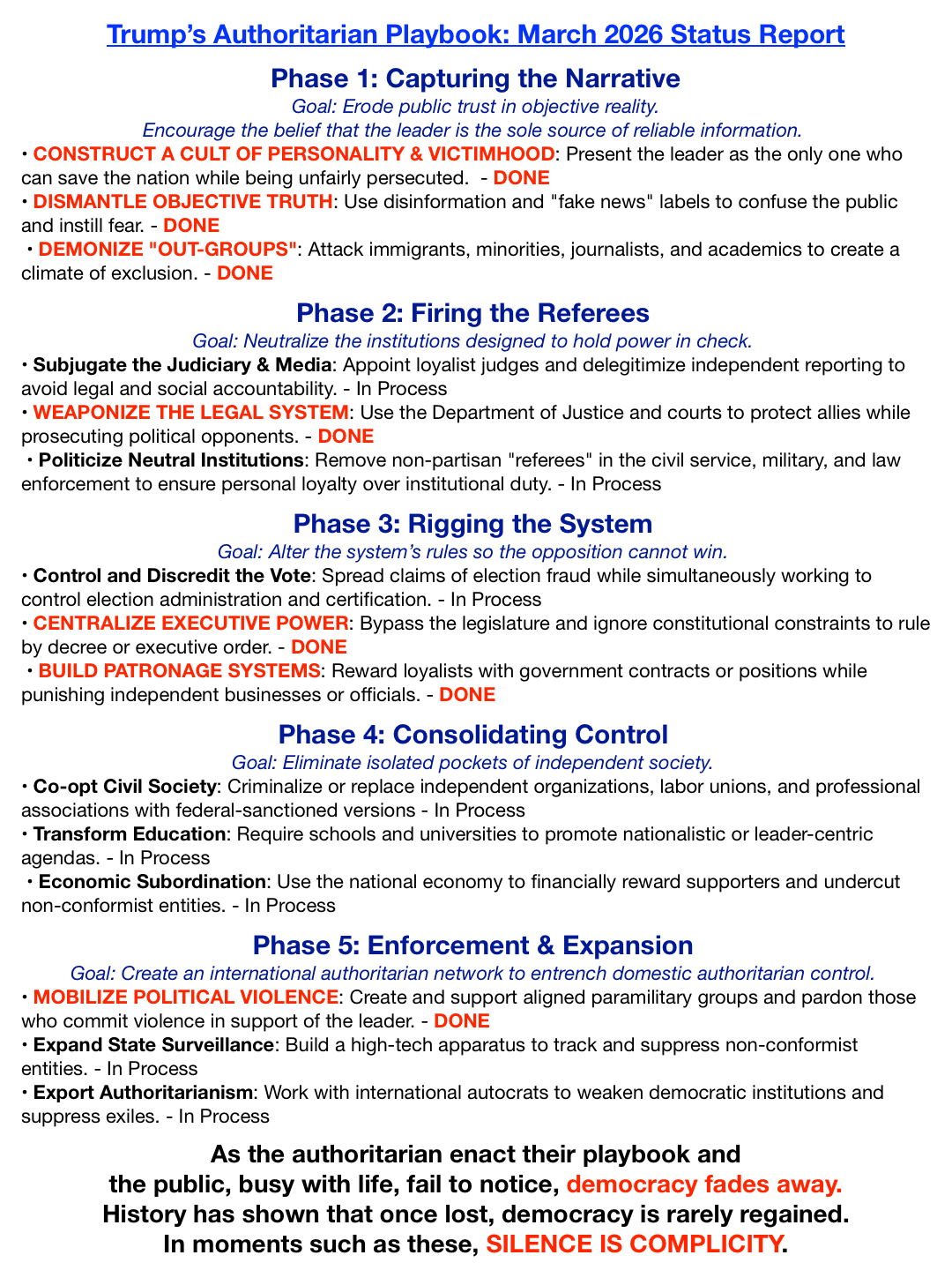
Contemporary authoritarians rarely seize power in a single dramatic moment. They follow a systematic, well-documented sequence: first destroying trust in shared reality, delegitimizing independent institutions, while casting themselves as the victims of vast conspiracies.
Once truth is contested and institutions weakened, they move to capture courts, law enforcement, regulatory agencies, and the civil service—transforming the machinery of government into an instrument of personal power.
With institutional checks disabled, the next phase is direct social control: scapegoating targeted groups, reshaping education, criminalizing civil society, cultivating militias, and normalizing political violence. These tactics create a climate of fear, compliance, and self-censorship.
Only after these foundations are in place do autocrats consolidate permanent authority—exploiting crises to claim emergency powers, corrupting elections while preserving their facade, rewriting legal constraints, expanding surveillance, and exporting their methods abroad.
Democracies rarely fall all at once. They erode gradually, through the steady implementation of the authoritarian playbook and the public’s failure to confront it.
Video explanation (6 minutes)
PHASE I: INITIAL DISRUPTION AND DELEGITIMIZATION
The first objective of an aspiring authoritarian is to shatter the public’s ability to trust any institution other than the leader himself. This phase is not about policy; it is about destabilizing the foundations of democratic legitimacy. The tactics are consistent across modern autocracies: flooding the information space with falsehoods, declaring the press corrupt, inventing shadowy enemies, and preemptively discrediting elections.
When citizens no longer know what is true, whom to trust, or whether democratic processes are fair, the leader gains the freedom to redefine reality. Confusion and cynicism are not unfortunate side effects—they are the intended outcome. This psychological softening prepares the ground for the institutional capture that follows.
1. Construct a narrative of personal victimhood
Authoritarian leaders begin by portraying themselves as persecuted by “corrupt elites,” hostile institutions, minorities, or a “deep state.” This creates a moral justification for later abuses of power: if the system is attacking them unfairly, then any response becomes legitimate.
Example: Trump repeatedly claimed that a “deep state” within the U.S. government conspired to undermine him, including the FBI, DOJ, intelligence community, and independent journalists.
Reference: https://apnews.com/article/aaeb07814bb8b6b3fe595f5b68e4163a
2. Undermine objective truth through disinformation
The leader saturates public discourse with falsehoods, conspiracies, contradictory statements, and attacks on evidence. The aim is not to persuade but to confuse—making citizens dependent on the leader’s narrative.
Example: Trump promoted baseless claims of widespread voter fraud, contradicted his own health agencies during COVID, and made more than 30,000 false statements as documented by The Washington Post.
Reference: https://www.washingtonpost.com/graphics/politics/trump-claims-database/
3. Attack independent media and construct a loyal propaganda ecosystem
Authoritarians delegitimize the press to eliminate scrutiny. They label journalists as enemies, threaten licenses, block access, and reward partisan media that echo their narratives.
Example: Trump called the press “the enemy of the people,” threatened NBC’s broadcast license after negative coverage, and promoted conspiracy prone news organizations like OANN and Newsmax. In 2025, the Pentagon restricted access for longstanding defense reporters and replaced them with right-wing loyalists.
References:
https://www.theatlantic.com/magazine/archive/2021/12/autocracy-inc/620526/
https://time.com/7327799/pentagon-press-corps-hegseth-restrictions-right-wing-media/
https://www.nytimes.com/2026/03/14/world/middleeast/fcc-broadcasters-iran-war.html?smid=nytcore-ios-share
4. Scapegoat and demonize internal enemies
Autocrats strengthen support and justify repression by blaming vulnerable groups—immigrants, minorities, journalists, academics—for social and economic problems.
Example: Trump blamed immigrants for crime and disease, described minority communities as “infested,” and questioned a federal judge’s impartiality because of his Mexican heritage.
Reference: https://www.theguardian.com/us-news/article/2024/jul/13/ruth-ben-ghiat-strongmen-book-authoritarian-playbook
5. Discredit elections long before manipulating them
Laying the groundwork for future election interference begins early. Autocrats claim fraud before proof exists, priming supporters to reject unfavorable results.
Example: Trump insisted the 2016 election was “rigged” before winning it, and spent years alleging systemic fraud without evidence.
Reference: https://abcnews.go.com/Politics/trump-longstanding-history-calling-elections-rigged-doesnt-results/story?id=74126926
PHASE II: INSTITUTIONAL CAPTURE
Once the public’s trust in democracy is weakened, the next step is to seize control of the institutions capable of checking executive power. Autocrats replace nonpartisan officials with loyalists, politicize law enforcement, pressure courts, manipulate regulatory agencies, and convert the civil service into an arm of personal rule.
This phase is methodical. The goal is not to eliminate institutions outright, but to hollow them out—leaving the outward appearance of normal governance while replacing their internal functions with loyalty enforcement. The legal system becomes a weapon, elections become administrative obstacles to be managed, and the machinery of the state becomes a tool for punishing critics and rewarding supporters.
6. Capture courts, prosecutors, election officials, and regulatory bodies
Autocrats install loyalists into the judiciary, law enforcement, and regulatory agencies. They pressure officials to violate norms, intervene in elections, and privilege allies.
Example: On December 5, 2020, Trump called Georgia Gov. Brian Kemp to urge him to overturn the 2020 results. A Senate Judiciary Committee report concluded the U.S. was “only a half-step away from a full-blown constitutional crisis.”
Reference: https://en.wikipedia.org/wiki/Attempts_to_overturn_the_2020_United_States_presidential_election
7. Politicize the military and law enforcement
Autocrats push military leaders to act domestically, promote loyal officers, and pressure the armed forces to defend the regime rather than the constitution.
Example: Trump ordered the forced clearing of peaceful protesters in Lafayette Square (June 2020) and asked advisers about deploying the military to overturn the 2020 election.
References:
https://www.forbes.com/sites/nicholasreimann/2020/12/19/trump-reportedly-asked-advisors-about-deploying-military-to-overturn-election
https://newrepublic.com/article/198708/trump-military-anti-immigration-dhs-leaked-memo
8. Weaponize the legal system against opponents
Investigations become tools of intimidation. Prosecutions target critics, while allies receive immunity, pardons (2000,) or special protection.
Example: Trump repeatedly demanded the DOJ prosecute Hillary Clinton, James Comey, Adam Schiff, Letitia James, and others. Under his pressure, the DOJ pursued politically motivated investigations.
References:
https://www.politico.com/news/2025/10/10/trump-doj-prosecutions-comey-james-00601838
https://www.newyorker.com/magazine/2025/11/24/the-meaning-of-trumps-presidential-pardons
https://www.npr.org/2024/10/22/nx-s1-5155032/trump-makes-more-than-100-threats-to-prosecute-or-punish-perceived-enemies
9. Purge and politicize the civil service
Career officials are replaced with loyalists. Expertise is devalued. Long-standing norms of nonpartisan governance collapse.
Example: Trump’s October 2020 “Schedule F” executive order enabled mass firing of protected career federal workers and replacing them with political appointees.
Reference: https://journals.law.harvard.edu/lpr/2020/11/17/president-trump-issued-a-schedule-f-bomb/
10. Centralize executive authority and bypass the legislature
Autocrats rely on emergency declarations, executive orders, unilateral deployments, and procedural manipulation to sideline Congress and override state authority.
Example: In June 2025, Trump mobilized active-duty Marines for operations in Los Angeles and deployed federal forces despite California’s governor declaring no state of emergency and explicitly rejecting federal intervention.
References:
https://cronkitenews.azpbs.org/2025/06/19/donald-trump-national-guard-ice-protests-legal-debate/
https://www.npr.org/2025/06/09/g-s1-71640/trump-mobilizes-marines-for-duty-in-los-angeles
11. Build political patronage systems to reward loyalty and punish independence
Economic benefits and government assistance are tied to political alignment. Opponents are denied resources; loyalists are favored.
Example: Analyses show Trump’s administration funneled disaster aid disproportionately to red states and withheld resources from states led by critics.
Reference: https://www.eenews.net/articles/does-trump-favor-red-states-when-disasters-hit-we-looked/
12. Transform the economy into a tool of political control
Authoritarian regimes use contracts, licenses, tax benefits, and economic pressure to enforce obedience.
Example: Trump attempted to steer federal spending to his own properties and punished companies like Amazon for perceived personal slights.
Reference: https://jpr.winchesteruniversitypress.org/articles/100/files/submission/proof/100-1-654-1-10-20211220.pdf
PHASE III: SOCIAL CONTROL AND COERCION
With institutions compromised, the authoritarian turns toward reshaping society itself. This phase is about enforcing obedience through fear, incentives, and the suppression of alternative sources of power. Independent civil society groups are harassed or dismantled; curricula and cultural institutions are redirected toward loyalty; militias and vigilante groups are cultivated; and political violence becomes normalized or openly encouraged.
The purpose is not only to intimidate opponents but also to signal to ordinary citizens that opposition is risky and compliance is safer. This produces self-censorship—one of the most powerful stabilizers of authoritarian rule. As fear replaces trust and violence replaces persuasion, society becomes dependent on the leader’s approval for security, mobility, and economic opportunity.
13. Require educational institutions to promote the authoritarian’s agenda
Curriculum is rewritten, dissenting educators are removed, and historical narratives are sanitized to cultivate ideological conformity.
Example: Trump’s 1776 Commission sought to replace academic history with a “patriotic education” that downplayed racism and attacked universities as “left-wing indoctrination centers.”
Reference: https://www.washingtonpost.com/politics/2024/09/02/trump-1776-commission-education/
14. Criminalize or replace independent civil society
Non-governmental organizations, watchdog organizations, and advocacy groups are defunded, harassed, or replaced by regime-controlled entities.
Example: Trump prepared a sweeping crackdown on nonprofit watchdog groups, including revoking tax-exempt status and launching politically motivated investigations.
Reference: https://www.theguardian.com/us-news/2024/dec/18/trump-non-profits-watchdog
15. Mobilize paramilitary or quasi-military loyalists
Authoritarian leaders encourage extralegal groups—militias, vigilantes, partisan enforcement units—to intimidate opponents.
Example: During the 2020 debate, Trump told the Proud Boys to “stand back and stand by,” signaling readiness to deploy a violent base.
Reference: https://www.politifact.com/article/2020/sep/30/context-donald-trumps-stand-back-and-stand-debate-/
16. Encourage or excuse political violence and cultivate fear
Violence becomes a political weapon. Selective punishment teaches opponents that resistance will be met with retaliation.
Example: Trump has repeatedly praised January 6 attackers as “patriots,” signaled support for political violence, and pardoned about 1,500 Jan 6 insurrectionists.
Reference: https://law.stanford.edu/podcast/trumps-pardons-political-violence-hate-groups-and-the-rule-of-law/
17. Control or co-opt labor unions and professional associations
Independent unions and organizations like the American Bar Association are targeted, discredited, or politically captured.
Example: Trump weakened federal employee unions, supported “right-to-work” expansions, and removed the ABA’s role in judicial vetting.
Reference: https://www.reuters.com/legal/government/justice-department-curtails-aba-role-vetting-trumps-judicial-nominees-2025-05-29/
18. Restrict mobility and citizenship rights
Authoritarians manipulate passports, citizenship, and travel to control dissidents.
Example: Trump has asked the Supreme Court to end birthright citizenship and has explored revoking citizenship of foreign-born American citizens.
References:
https://www.ms.now/deadline-white-house/deadline-legal-blog/birthright-citizenship-trump-supreme-court-rcna234469
https://theweek.com/politics/unmaking-americans-trump-revoke-citizenship
PHASE IV: CONSOLIDATION AND INTERNATIONALIZATION
In the final phase, the authoritarian seeks to make his power permanent and unaccountable. Crises—real or manufactured—are used to justify emergency powers and sweeping legal changes. Elections are corrupted while maintaining a facade of democratic process. Constitutional limits are ignored or rewritten. Surveillance expands, dissent is criminalized, and a cult of personality elevates the leader as the embodiment of the nation.
Modern autocrats also look outward. They cooperate with foreign strongmen, spread disinformation across borders, and undermine democratic alliances. Some pursue critics abroad through diplomatic pressure, passport manipulation, or international law enforcement mechanisms.
Phase IV never truly ends; it is the stage in which the leader converts the state into an entrenched authoritarian system that can outlast him, shape international norms, and resist democratic reversal.
19. Exploit or manufacture crises to seize extraordinary powers
Emergencies—real or invented—justify suspending democratic norms.
Example: Trump used border and crime “emergencies” and civil unrest to justify expanded executive powers and threatened to invoke the Insurrection Act.
Reference: https://apnews.com/article/59ad35bc6437f529b08cbd2169e88bde
20. Corrupt elections while preserving their facade
Autocrats manipulate rules, suppress voters, intimidate administrators, and corrupt vote certification while still holding “elections.”
Example: Trump pressured Georgia’s secretary of state to “find 11,780 votes,” pushed fake electors, and backed state laws restricting voter assistance.
Reference: https://www.brennancenter.org/our-work/research-reports/fact-check-trumps-georgia-call-raffensperger
21. Rewrite or ignore legal and constitutional constraints
Authoritarians eliminate term limits, ignore court rulings, and redefine oversight.
Example: Trump asserted the Constitution could be “terminated,” claimed absolute immunity, and ignored multiple judicial constraints.
References:
https://www.congress.gov/bill/117th-congress/house-resolution/1527/text
https://www.independent.co.uk/news/world/americas/us-politics/trump-federal-court-ruling-ignore-b2792939.html
22. Expand surveillance, suppress dissent, and build leader worship
The regime monitors opponents, criminalizes protest, censors critics, and elevates the leader as the embodiment of the nation.
Example: Trump pushed new tracking efforts against protesters and depicted himself as the “only one” able to fix America.
Reference: https://salve.edu/news/news-listing/blueprint-autocracy-ruth-ben-ghiat
23. Transnational repression of diaspora and exile communities
Modern autocrats extend their reach beyond national borders—pressuring dissidents abroad, assisting foreign regimes in pursuing exiles, weakening protections for targeted activists, or enabling hostile governments to intimidate critics living in the United States.
Example: Trump sanctioned International Criminal Court investigators examining abuses by U.S. forces, signaled a willingness to hand Turkish dissidents to Turkey’s Erdogan, and called Vladimir Putin’s request to interrogate U.S.-based activists an “incredible offer.”
References:
https://foreignpolicy.com/2025/10/08/trump-russia-iran-dissidents-democracy-repression/
https://www.iranintl.com/en/202510139225
24. Manipulate and weaponize international institutions
Autocrats undermine or co-opt bodies like the WHO, NATO, UN, and Interpol to weaken democratic alliances and launder legitimacy.
Example: Trump withdrew the US from WHO, U.N. Human Rights Council, UNESCO, Open Skies Treaty, U.N. Global Compact on Migration, Trans-Pacific Partnership, and others; while using foreign policy to reward authoritarian-aligned leaders and punish non-supporters.
Reference: https://www.pbs.org/newshour/show/how-sanctions-imposed-by-trump-are-taking-a-toll-on-the-international-criminal-court
25. Participate in international authoritarian cooperation
Autocracies share propaganda techniques, cyber tools, disinformation tactics, and political strategies.
Example: Trump consistently echoed narratives from Russia and Hungary, praised authoritarian leaders, and sought closer alignment with illiberal regimes.
References:
https://www.theatlantic.com/magazine/archive/2021/12/autocracy-inc/620526/
https://www.bbc.com/news/world-europe-44852812
SILENCE TRULY IS COMPLICITY
Democracies crumble gradually, steadily degraded by the deliberate application of the authoritarian playbook and enabled by the public’s willful inaction.
Once lost, citizens rarely regain or fully retain the freedoms they allowed to slip away.
Democracy is not self-sustaining; it never has been. It requires constant vigilance, repeated efforts to correct injustice, and an ongoing commitment to creating a more perfect union.
In moments such as these, silence is complicity.
Hayward Zwerling
17 November 2025
A partial solution to America’s authoritarian trend can be read here: A Governor’s Duty: Protecting Massachusetts from Federal Authoritarianism
Sources
Authoritarian Playbook 2025, https://www.authoritarianplaybook2025.org/
Anne Applebaum, Autocracy, Inc., https://www.theatlantic.com/magazine/archive/2021/12/autocracy-inc/620526/
Ruth Ben-Ghiat, Strongmen, https://www.theguardian.com/us-news/article/2024/jul/13/ruth-ben-ghiat-strongmen-book-authoritarian-playbook
others