
Beyond the Rigged Rules: A Blueprint for Structural Reform
Synopsis:
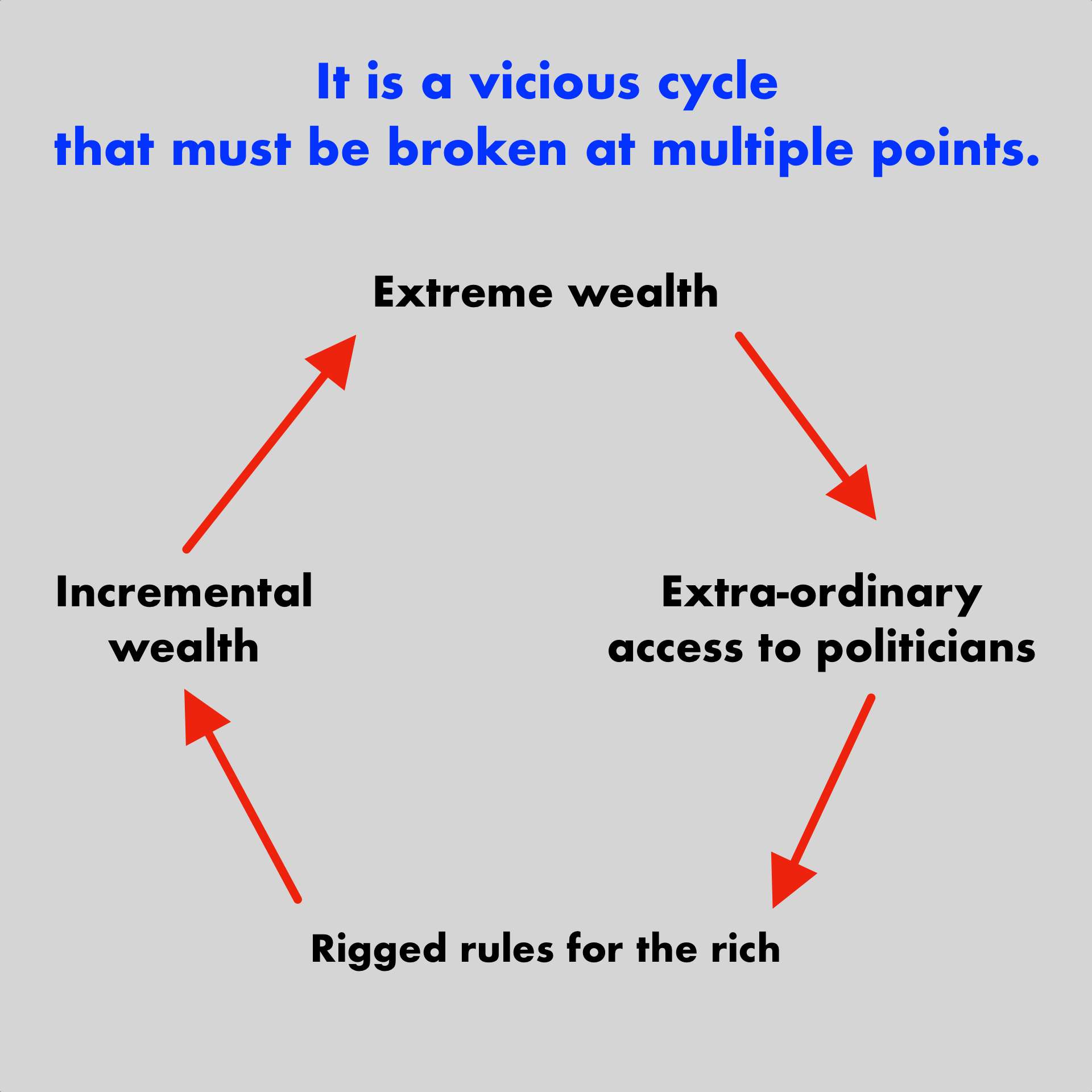
• Break the Vicious Circle: The wealthiest 0.001% of Americans use their money to purchase political influence and to advance their agenda of acquiring more wealth–which they use to further rig the rules for the rich.
• Repair An Aberrant Supreme Court: The Roberts Court has repeatedly overturned longstanding precedents, ignored historical norms of judicial behavior, appropriated political power to itself, and granted the President king-like powers. This behavior can be reined in by expanding the Court to 13 Justices, returning to the historic norm of matching the number of Justices with the number of federal judicial circuits.
• Impose A Billion Dollar Wealth Ceiling: As it is impossible to prevent the extremely wealthy from exercising outsized control over our government, the only solution is to limit the total accumulation of personal wealth to an amount below what is required to control our democracy.
• Implement an Equitable Corporate and Personal Wealth Tax: Replacing our inequitable, loophole-ridden federal tax structure with a uniform 1% corporate wealth tax and a graduated personal wealth tax would eliminate the federal tax burden for the bottom 90% of Americans, while raising more revenue and shifting the burden to those who can easily afford it.
• Create a Government that Works for All: By reducing the political power of the ultra-wealthy and raising sufficient revenue to fund essential services, we can build a government and democracy that works for all Americans.
The America I inherited included the promise of the American Dream—a compact that has now been fundamentally betrayed. Today, a majority of Americans have expressed a lack of trust in our government, and 62% are dissatisfied with the way our democracy is working. This disillusionment is a rational response to a system that has been rigged to prioritize the interests of the wealthiest 0.001% over the rest of America. And yet this decline is not inevitable—it is a choice we can reverse. We must restructure our democracy so it restores the American Dream for all Americans.
A Dysfunctional Government, an Inequitable Society, and a Lost Dream
Congress’s political polarization has driven its approval rating into the teens.
The Supreme Court’s approval rating has reached an historic low—likely because the Justices have chosen to overturn long-standing precedents, ignore established judicial norms, and increasingly issue consequential rulings via the “shadow docket,” deciding cases without full briefings or oral arguments, and delivering perfunctory, unsigned opinions.
Our 250-year-old Constitution is apparently irreparable, having last been meaningfully amended more than fifty years ago.
Amidst this stagnation, President Trump has used his second term to dismantle the foundations of our government, press, and scientific, educational, and legal communities, routinely ignoring court mandates.
This institutional erosion has led numerous prominent figures, social and political scientists to conclude that America has crossed a threshold, America is no longer a democracy.
This political decay is mirrored by staggering economic disparity. America’s richest 1,000 families now own twice the total wealth ($8 T) of the 66 million Americans in the bottom half of the wealth distribution ($4 T.) Consequently, Americans viscerally understand that the rules are rigged for the rich; for most citizens, the American Dream is no longer an attainable reality.
Create an Equitable and Effective Post-Trump Government
The governmental structure that existed prior to Trump’s second term had failed to definitively address four critical crises: climate deterioration, the progressive concentration of immense wealth, the erosion of social mobility, and the emergence of a two-tiered justice system, one for the wealthy and another for everyone else.
Assuming we eventually rid ourselves of Donald Trump, his authoritarian supporters and aspirants, and assuming we want to build a democracy that works for everybody, it is clear that returning our government to its pre-Trump status quo did not work then, and so it will not work if we try the same thing a second time.
To create a government that serves the many rather than the few, we need a new paradigm, a new North Star: a democracy that is self-correcting and fundamentally designed to work for all Americans.
Polling data has shown that Americans believe our government would work for the average American if it:
- Reduced the influence of money in politics
- Eliminated government corruption, improved government efficiency, transparency, accountability
- Reduced inflation and the price of housing, food, energy, healthcare, and daily necessities.
- Eliminated political gerrymandering and the Electoral College, instituted ranked-choice voting, expanded beyond our two-party system
- Strengthened our social safety net, Social Security, Medicaid, and Medicare
- Created a stable and effective immigration system
- Ended political polarization
“The influence of money distorts everything” – Senator Barry Goldwater
I believe the central cause of our democratic failure is a government that has become increasingly rigged in favor of the extremely wealthy. This has produced extreme economic inequality and concentrated extraordinary wealth in a tiny fraction of the population.
Benjamin Franklin warned us of this problem 250 years ago when he wrote:
“An enormous proportion of property vested in a few individuals is dangerous to the rights, and destructive of the common happiness of mankind…”
Many others have made similar, and even more damning observations regarding the influence of money on a democracy.
Extreme wealth provides unparalleled access to political influence. This access ensures that the rules of society are continually modified to favor the priorities of the wealthiest, further enriching a tiny subset of Americans and granting them even greater power to shape our government. It is a vicious circle that must be broken at multiple points.
Repair An Aberrant Supreme Court: Restore Judicial Rationality and Balance
Restoring judicial balance is the necessary pre-condition to create a democracy that works for most Americans. When a truly pro-democracy party controls the presidency and Congress, the Supreme Court must be reconfigured so the bench prioritizes protecting the constitutional rights of all citizens rather than the interests of a donor class.
Prior to 1929, the number of Supreme Court justices essentially matched the number of federal judicial circuits. Today, that structural logic has been abandoned: we have only nine justices overseeing 13 judicial circuits.
Given that the Justices are overwhelmed with an ever-increasing number of complex cases, there is clear justification to expand the bench. This realignment would arrest the Court’s recent aggressive rightward drift and provide a more manageable docket, enabling the Justices to address critical issues with the deliberation they deserve rather than defaulting to the “shadow docket”—the practice of issuing consequential, unsigned, and perfunctory rulings without full briefing.
The philosophy of the Roberts Court has led to a historic decline in public approval. A bipartisan majority believes the Court wrongly decided Citizens United when it gave corporations the right to spend unlimited sums on political expenditures. A similar bipartisan majority holds that no president is above the law and that the Court erred in Trump v. United States, 603 U.S. 593 (2024). Expanding the Court to thirteen Justices would allow the bench to align its judicial philosophy with the body politic, rectifying these historically aberrant rulings and beginning the process of restoring public trust.
A rebalanced Court would also be better positioned to support the constitutionality of restructuring America’s tax system, including a personal and corporate wealth tax. As the Supreme Court has already ruled that corporations are people, it follows logically that if a personal wealth tax is constitutional, a corporate wealth tax must be as well.
Restoring judicial balance alone will not unrig our rigged system; we must also reconfigure the distribution of American wealth and political power.
Impose A Billion Dollar Wealth Ceiling: Level the Political Playing Field
America’s billionaire class has used their wealth to exert disproportionate political power to engineer a tax structure that ensures they never pay their fair share. This enables a self-reinforcing cycle: the accumulation of vast resources allows for the further rigging of the rules, which in turn accelerates the concentration of wealth.
Today, one multi-billionaire can single-handedly finance the entire campaign of a senator, judge, congressperson, president—or provide a lifetime of entertainment for a Justice. In the 2024 election cycle, a mere 300 billionaires were responsible for nearly 20% of political spending.
This concentrated capital allows a tiny elite to bend our political institutions toward their private needs, drowning out the voices of the 66 million Americans in the bottom half of the wealth distribution.
To reclaim our democracy, the wealth of the multi-billionaire class must be serially taxed until it no longer poses a threat to our political institutions. This is not a radical fringe idea; it is a public mandate. 67% of Americans believe $1 billion is “far more than any person needs, even if they live a lavish lifestyle” and 63% of Americans, including a majority of Republicans, support a billionaire wealth tax.
One way to eliminate the distorting power of the billionaire class is to establish a “wealth ceiling” of $1 billion. By instituting an extreme wealth tax, as detailed in my essay “Tax Billionaires’ Wealth – Free the 95%,” we can dismantle the rigged rules and create a government that works for the American people.
In addition to deprecating the wealth derived political power of the billionaire class, we need to introduce an equitable corporate tax structure which circumvents today’s loophole rated corporate income tax structure.
Enact A Corporate Wealth Tax: From Every Business According to Their Ability to Pay
The rigged federal corporate tax structure allowed 88 major profitable U.S. corporations to pay zero federal income tax on $105 billion in pre-tax income. This systemic failure shifts the cost of the nation’s infrastructure, which is essential to corporate America, to the average American taxpayer.
To eliminate these rigged rules, Congress should institute a uniform 1% federal corporate wealth tax. Unlike an income tax, which relies on opaque accounting, a corporate wealth tax is an objective calculation: Market Cap (Shares Outstanding x Average Share Price) x Tax Rate.
To close the “debt-loading” loophole, the corporate tax is assessed on this total market valuation without the strategic debt deductions allowed in the personal tax code. Assessing tax on market valuation ensures a corporation’s obligation is tied to its perceived value by investors rather than its ability to engineer artificial liabilities.
Currently, total business wealth in the U.S. is roughly $111 trillion, according to the Federal Reserve’s valuation of corporate and non-corporate equity. The total federal tax contributions from these entities are approximately $572 billion, amounting to 0.5% of the total business wealth.
Moving to a transparent 1% corporate wealth tax for public corporations would eliminate the complex web of loopholes that currently allow profitable corporations to avoid paying taxes. This shift would raise about $1.1 trillion in federal revenue. As many billionaires already pay an annual management fee of 2% to their financial firms simply to oversee their assets, a 1% “maintenance fee” to sustain the democratic and legal infrastructure of the United States is eminently reasonable.
To discourage the flight of public equity into the more opaque private sector, private firms would be taxed at 1% of a standardized valuation multiple of their annual earnings, typically 10 to 12x, excluding any acquired tax-deductible predatory debt. This formula provides a consistent and transparent approximation of fair market value, ensuring that private wealth remains subject to the same structural standards as public corporations.
By taxing wealth directly at the source, we ensure that nearly $1.1 trillion is secured at the corporate level before it can be shielded by complex accounting or offshore transfers. This structure acts as a critical safety net by capturing an institutional tax from foreign investors and institutional holdings that currently pay nothing to the Treasury. Simultaneously, individual American shareholders should receive a “Corporate Withholding Credit” for the value of their stock, which serves as a dollar-for-dollar offset against their personal wealth tax liability.

Replace Our Inversely Graduated Personal Federal Income Tax with a Graduated Wealth Tax
Our rigged federal income tax code results in a lower effective tax rate for the wealthiest than for America’s middle class.
As Warren Buffett wrote in his NY Times essay (2011):
“Last year my federal tax bill … was only 17.4 percent of my taxable income—and that’s actually a lower percentage than was paid by any of the other 20 people in our office. Their tax burdens ranged from 33 percent to 41 percent and averaged 36 percent.”
Because the extremely wealthy do not pay their fair share of taxes, America should abandon our inversely graduated federal income tax structure and institute a graduated personal wealth tax.
The proposed graduated wealth tax (see chart above) is, at its core, a moral choice: it ensures taxes are paid by those most able to afford them while eliminating the federal tax burden entirely for the bottom 90% of Americans. This system would raise more revenue than our current income tax, enabling the funding of the services that are necessary to make the American Dream a reality for all.
To ensure fairness for asset-heavy but debt-burdened citizens—such as family farmers—the personal wealth tax is assessed on net wealth, defined as the fair market value of all assets minus legitimate liabilities. By utilizing market value rather than ‘face value,’ the system remains immune to artificial devaluation strategies; for instance, an individual purchasing high-risk ‘junk debt’ would only receive a deduction for the actual market price of that debt, ensuring that net worth is measured by objective economic reality rather than engineered liabilities.
To prevent double-taxation on corporate holdings, individuals then use the Corporate Withholding Credit to offset and zero out the tax liability for those specific assets on their personal filing. This reconciliation ensures individuals are only taxed on the wealth they actually own and are never taxed on the same dollar twice.
As the chart below illustrates, this creates a profound shift in household economics. By eliminating federal income and payroll taxes for the “Bottom 90%,” the system restores an average of $1,000 per month to the family budget—capital previously lost to a rigged tax code
A Democracy Prioritized to Help “We the People,” Funded By Those Who Can
Shifting from income-based taxation to a federal personal and corporate wealth tax—combined with a definitive $1 billion wealth ceiling—would generate more than $8 trillion in annual federal revenue. This approximately doubles current federal tax receipts, funded entirely by those who could afford to pay.
Most importantly, these measures would significantly neutralize the disproportionate political power of the ultra-wealthy, whose fortunes currently grant them unimaginable influence over legislators, judges, and justices. By reclaiming this capital, we would have the resources necessary to build a more equitable society and restore our democratic institutions.
With annual federal revenue exceeding $8 trillion, the United States could fundamentally transform the American experience.
We could:
- Fund Medicare for All (~$1.6T)
- Provide tuition-free public college and vocational training (~$200B)
- Extend Social Security’s solvency for 75 years (~$200B)
- Establish universal childcare (~$600B)
- Fully fund universal housing assistance (~$60B)
- Eliminate federal taxes for the bottom 90% of Americans
- Systematically reduce the national debt
This is the roadmap to unrigging our system. By prioritizing the needs of the many over the influence of the few, we can finally fulfill the promise of a government that works for all its citizens.
Potential Arguments Against a Graduated Wealth Tax
“Corporations will leave”
Critics will warn that a wealth tax would drive corporations offshore. But “tax inversions,” the practice of relocating a legal address to Ireland or Canada, do not exempt corporations from U.S. taxes on domestic sales. No corporation has ever abandoned the American consumer market, and none will; it remains the world’s most lucrative economy. Corporations may change their mailing address, but they will never abandon their customers.
“Billionaires will leave”
The primary objective of the billionaire wealth tax is to mitigate their disproportionate influence on American society. If the decabillionaires, centibillionaires, and potential trillionaire choose to renounce their American citizenship to avoid taxes, they will be legally barred from contributing to political campaigns. In such an event, the primary goal of restoring political balance will have been achieved. If the 1,000 billionaire families choose to remain American citizens and their fortunes are capped at $1 billion, they will continue to live extraordinarily well.
“A wealth tax will reduce innovation.”
Every pillar of modern wealth—from the microprocessor to the internet—originated as a publicly funded breakthrough. A 1% wealth tax is not a penalty on success; it is a long-overdue maintenance fee for the “infrastructure of discovery” that made that success possible. Furthermore, innovation is a product of intrinsic human drive, not marginal tax rates. Most breakthroughs occur early in a career, driven by a desire for discovery or problem-solving long before the innovator achieves billionaire status. In those rare instances where vast capital is truly required for progress, assets can be transferred to charitable endowments dedicated to innovation. This preserves the capital’s ability to spur advancement while mitigating the excessive political influence that stems from concentrated private wealth.
“It is a political impossibility.”
Structural change is only “impossible” until it becomes inevitable. History consistently demonstrates that ideas once deemed “impossible” are the precursors to new realities: the American Revolution in 1776, Social Security in 1935, Medicare in 1965, and the Apollo moon landing in 1969.
Conclusion
The America I inherited carried a promise: every child born in America could build a life of dignity. But decade by decade, the rules have been methodically rigged by the rich, for the rich.
Consider the scale. On one side stands a handful of billionaires whose political spending now rivals the collective voice of the American middle class. On the other stand 250 million Americans, each with a single vote. Despite the fact that three-quarters of Americans believe our “political system needs complete reform or major changes,” the machinery of government remains subservient to the interests of the ultra-wealthy.
America has the resources to build a government that works for everyone. By replacing a loophole-ridden and inequitable income tax with a transparent wealth tax, we can eliminate the federal tax burden on the middle class and re-awaken the American Dream.
The blueprint exists. The resources exist. The public mandate for structural reform is overwhelming. The only remaining question is whether our political system will finally respond to the many, or continue to serve the few. History will not forgive us if we choose the latter.
Hayward Zwerling
13 May 2026